Answering the need to quickly locate leaks in compressed air systems, this guide highlights five top options with practical buyer tips. The best picks are suited for industrial technicians, HVAC professionals, and maintenance teams who require precise leak localization, minimal downtime, and clear visual or auditory cues. The table below provides a quick snapshot to help compare key points at a glance.
| Product | Best For | Core Feature | Typical Use |
|---|---|---|---|
| FOTRIC TD2e Acoustic Imaging Camera | Industrial plants; automotive; heavy machinery | 64 MEMS mics with beamforming; 2k–100k Hz ultrasound | Visual acoustic photos to pinpoint leaks |
| Vanlison Ultrasonic Leak Detector | Field service; automotive and HVAC | 38–42 kHz ultrasonic detection; light and portable | |
| allsun Ultrasonic Leak Detector Kit | General maintenance; DIY to pro | 36–44 kHz with dual probes; visual LED and tone cues | Dual-probe access to confined areas |
| Amprobe ULD-405 Ultrasonic Leak Detector | Industrial plants; commissioning | 20–90 kHz range; LCD display with bargraph | Wide-range leak detection and easy visualization |
| Elitech CLD-100 Freon Leak Detector | HVAC technicians; refrigeration systems | Traditional corona sensor; fast response | Halogen refrigerants and blends detection |
FOTRIC TD2e Acoustic Imaging Camera
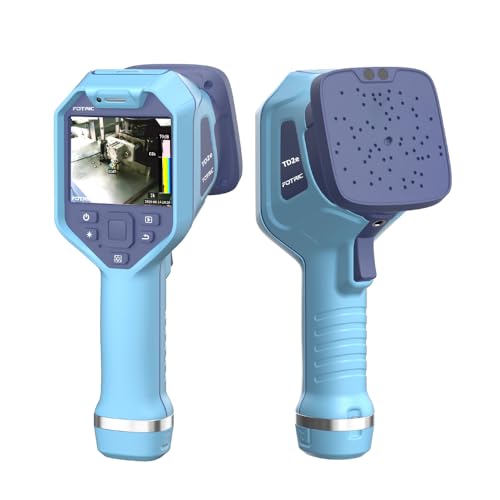
The FOTRIC TD2e uses a 64 MEMS microphone array and a beamforming algorithm to capture both audible and ultrasonic signals (2 kHz to 100 kHz). The device overlays acoustic data onto a 5 MP optical image, producing real-time photos that show leak sources clearly. Best for: industrial facilities with noisy environments where high-frequency leaks must be isolated from ambient noise. This model excels at visualizing compressed air leaks, vacuum leaks, and vibration issues, reducing wasted energy and preventing downtime. Limitation: higher price point and learning curve compared with simpler detectors. Best for technicians who need precise, image-backed localization in complex setups.
Vanlison Ultrasonic Leak Detector

The Vanlison detector emphasizes portability and simplicity for on-site inspections. It operates in the 38–42 kHz ultrasonic range and includes a noise-isolating headset for noisy environments. Best for: field technicians in automotive, HVAC, or industrial plants who need a compact tool that reliably locates leaks without heavy training. Select this if you want a quick, portable solution with audible and visual feedback. Caution: may be less effective for very small leaks that fall outside the detector’s frequency band.
allsun Ultrasonic Leak Detector Kit
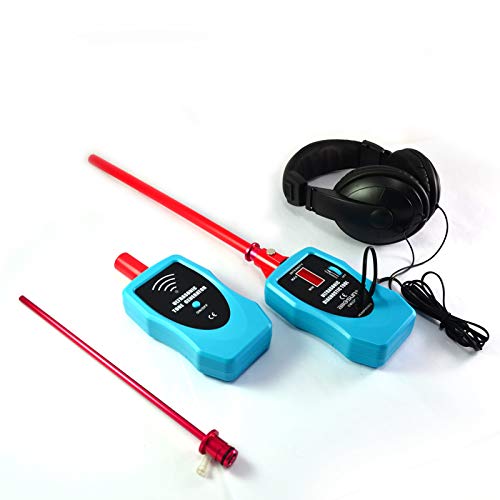
The allsun kit provides 36–44 kHz ultrasonic detection with dual probes for both airborne and contact measurements. It includes a rotary volume control and a tone or LED-based confirmation, improving accuracy in challenging spaces. Best for: technicians who need both air and contact probing to locate leaks around machinery casings, valves, and bearings. Better for: situations requiring probing around tight or noisy machinery. Limitation: may require careful probe handling to maximize sensitivity over long inspection sessions.
Amprobe ULD-405 Ultrasonic Leak Detector

Amprobe’s ULD-405 covers a broad 20–90 kHz range with an easy-to-read 2.5” LCD and bargraph. It offers adjustable sensitivity and volume controls, suitable for varying noise levels in industrial settings. Best for: maintenance teams needing a versatile detector that can adapt to many leak scenarios. Choose this if you prioritize visual readouts and straightforward controls. Caution: the wide range can pick up ambient noise; proper setup is essential to avoid false positives in very loud facilities.
Elitech CLD-100 Freon Leak Detector

The Elitech CLD-100 is a traditional corona sensor detector tailored for halogen refrigerants. It features a fast preheating time and adjustable sensitivity with a flexible probe for hard-to-reach areas. Best for: HVAC technicians focusing on refrigerant leaks in cars or commercial systems. Choose this if you frequently work with R-11, R-22, R-134A, or similar refrigerants. Limitation: primarily designed for halogenated refrigerants, so not ideal for non-halogen gas leaks.
Buying Guide: Key Considerations For Leak-Detection Equipment
- Leak type and environment: Choose frequency ranges (e.g., 20–90 kHz, 36–44 kHz, 38–42 kHz) that match the most common leak types in your systems and the ambient noise level you face.
- Detection method: Visual acoustic imaging (TD2e) vs. handheld ultrasonic detectors (Vanlison, allsun, Amprobe) offer different workflows. Visual tools simplify localization in complex setups, while handheld units excel in field mobility.
- Probes and access: Dual probes or flexible probes help reach tight spaces around valves, bearings, and pipe joints. Consider whether you need contact or air-leak probing for more accurate pinpointing.
- Ease of use versus depth: Some devices emphasize quick alerts and simple operation; others provide richer data and image-based localization. Match to technician skill level and project needs.
- Validation and reminders: Look for devices with audible, visual, or combined cues to confirm a leak source. Consistency in results reduces diagnostic time and downtime.
- Maintenance and longevity: Consider battery life, ruggedness, and whether the device supports replaceable parts (probes, batteries) for long-term use.
Frequently Asked Questions
- What frequency range is best for compressed air leaks? – Many air leaks are detected effectively in the 20–90 kHz range, but some ultra-high-frequency detectors (like 2 kHz–100 kHz) can reveal leaks that standard detectors miss in noisy environments.
- Should I choose a visual imaging camera or a traditional ultrasonic detector? – If you need precise leak localization with visual confirmation, a camera-based system is advantageous. For quick on-site checks, a handheld ultrasonic detector is often faster and more portable.
- Is dual-probe capability worth it? – Yes, dual probes improve access to confined areas and provide both airborne and surface measurements, increasing the chances of locating hard-to-reach leaks.
- Do these devices require extensive training? – Models range from beginner-friendly to professional-grade. TD2e and some kits offer intuitive interfaces, while others may require more practice to interpret signals accurately.
- Can these detectors be used for refrigerant leaks as well as air leaks? – Some detectors are designed for halogen refrigerants (Elitech CLD-100), while others target general gas, air, or vacuum leaks. Check the product’s stated scope before use.
- What’s a common limitation of ultrasonic detectors? – Ambient noise can affect sensitivity. Choose a model with noise-canceling features or a frequency range that minimizes interference for your work area.