If you’re seeking a commercial-grade dust collection system, this guide highlights top options that balance strong suction, portability, and ease of use for shop environments. The best fit depends on your space, volume of dust, and whether you need stationary power or mobile flexibility. The list below focuses on five systems that are well-suited for professional or hobby shops desiring consistent, efficient dust removal. See a concise comparison table of the chosen products after the intro to help you decide quickly.
| Product | Key Strength | Best For |
|---|---|---|
| WEN DC1300 | 1,300 CFM, 50-gallon bag, dual inlets | Medium to large shops needing steady, portable performance |
| Dustopper Turbo Bagger | Commercial-grade design, integrated components | Professional look and rugged use |
| POWERTEC DC5371 | 1 HP, 560 CFM, 1-micron bag | Small to compact shops or hobbyists |
| DEWALT DWXAF101 | 3-speed filtration with remote and timers | Controlled filtration with automation |
| VEVOR 2 HP Dust Collector | 1167 CFM, two-bag separation | Mid-sized shops needing strong continuous flow |
Introduction summary: This guide helps buyers compare common commercial dust collection systems by suction power, filtration quality, portability, and ease of installation. The selections emphasize systems that balance high airflow with practical setup for workshops of varying sizes. The buyers highlighted here range from serious hobbyists upgrading to small professional environments to larger spaces requiring robust, mobile dust collection solutions.
WEN DC1300: 1,300 CFM Desktop-Style Collector

The WEN DC1300 delivers up to 1,300 CFM with a 14-amp motor and a 50-gallon collection bag. It includes dual 4-inch inlets for connecting two tools at once, which helps maintain consistent air flow across multiple stationary machines. The vertical bag design reduces clog risk and simplifies emptying. This model is best for mid-sized shops where mobility is valued and users need reliable, straightforward operation. Caution: The unit’s 50-gallon bag is heavy when full, so plan for easy access and a proper collection area.
Dustopper Turbo Bagger: Commercial-Grade Mobile System

The Dustopper Turbo Bagger combines dust extraction with integrated vacuum-like performance in a mobile unit. It emphasizes a refined, commercial-grade design with custom brackets, secure latches, sealed fittings, and an X-Static anti-static kit. This system is better for shops aiming for a professional look and dependable long-term operation. Best for: professional spaces that value built-in reliability over ultra-compact footprint. Caution: Setup may require careful wiring and space planning to maximize mobility benefits.
POWERTEC 1 HP Wall Mount: Compact Yet Capable

The POWERTEC DC5371 is a wall-mounted dust collector designed for small professional shops or hobby spaces. It includes a 1-micron bag and a compact footprint, with a window to monitor dust levels. The Vortex Base design helps streamline airflow, producing improved efficiency versus some compact models. Best for: users who want a space-saving option without sacrificing filtration. Caution: Less suited for very large, continuous production tasks due to lower overall airflow compared to larger floor-standing units.
DEWALT DWXAF101: Filtration with Remote Convenience
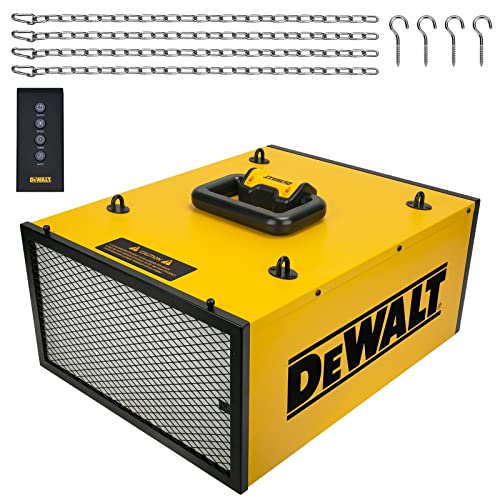
The DEWALT DWXAF101 focuses on filtration and automation, featuring a two-stage filtration system with a pre-filter and an H11 HEPA filter, capable of trapping over 95% of 0.3 μm particles. It also provides built-in timer settings and a remote for shop convenience. Best for: users who need tighter control over air quality and automated operation. Caution: Higher price and more complex setup may be challenging for very small shops.
VEVOR 2 HP: High-Capacity, Strong Flow

The VEVOR 2 HP dust collector delivers about 1,167 CFM with a robust motor and a two-bag separation design. It uses a cyclone-like approach to improve chip separation and packing efficiency, with a 39-gallon collection drum and independent casters for easy moving. Best for: mid-sized shops needing strong airflow and a manageable footprint. Caution: As a mobile unit, ensure stable placement to prevent tipping during transport.
Buying Guide: Key Purchase Considerations
- Shop size and layout: Estimate the total duct length and space for a dust collector with a mobile base versus a wall-mount design.
- Airflow and filtration: Higher CFM supports faster cleanup; consider micron-level bags or HEPA filtration for finer dust control.
- Filtration options: Two-stage filtration plus anti-static features can improve air quality and reduce particulate return to the shop.
- Portability vs. permanence: Decide if you need a unit that moves between machines or a fixed installation to maximize suction.
- Noise and maintenance: Look at motor power, noise levels, bag capacity, and ease of bag disposal.
- Compatibility: Check inlet sizes and ensure compatibility with your current tools and ducting plan.
Practical Buying Scenarios
- Best for mobile setups: Lightweight or wheeled models that can be relocated around the shop.
- Better for large-volume dust: Higher CFM units with bigger collection bags and efficient filtration.
- Choose this if you value automation: Systems with timers and remote controls help maintain air quality without constant attention.
- Avoid this if space is scarce: Very large floor units may not fit in small workshops without significant reorganization.
FAQ
- What is the difference between CFM and filtration efficiency? CFM measures air moved; filtration efficiency measures how much dust is captured prior to recirculation.
- Is a 1-micron bag enough for fine dust? It helps capture finer particles, but HEPA-grade filtration offers higher efficiency for very fine dust.
- Should I choose a wall-mount or a mobile unit? Wall-mount saves floor space; mobile units offer flexibility across machines or rooms.
- How important is a two-stage filtration? Two-stage filtration improves overall air quality by trapping more particulates before air returns to the shop.
- What maintenance is required? Regular bag replacement or cleaning, emptying collection drums, and inspecting seals for leaks.
- Can these systems handle metal chips or only wood dust? Most are designed for wood dust; confirm compatibility with your material types and use appropriate filters.