Choosing the right 96-well plate is essential for consistent cell culture results, whether in research or teaching labs. The options below highlight plates with flat or U-bottom designs, sterile treatment, and clear visibility to support high-quality observations, reliable data, and efficient workflow.
The following summary table provides a quick comparison of the five selected products, focusing on core attributes such as bottom design, sterility, and treatment. This helps you scan for features that matter most to your specific experiments.
| Product | Brand | Bottom Type | Treatment | |
|---|---|---|---|---|
| Weysat 20 Pcs 96 Well Tissue Culture Plates | Weysat | Flat Bottom | Clear Polystyrene | Sterile, Pack of 20 |
| Nest Scientific 96-Well Plate | Nest | Flat Bottom | Tissue Culture Treated | Sterile, 100 per Case |
| Celltreat 229195 96-Well Plate | Celltreat | Flat Bottom | Clear Polystyrene | Sterile, Pack of 50 |
| ADVANGENE U-Bottom 96 Well Plate | Advangene | U-Bottom | Tissue-Culture Treated | Sterile, Pack of 50 |
| SPL 96 Well Plate | SPL Life Sciences | Flat Bottom | Tissue Culture Treated | Sterile, Case of 50 |
Weysat 20 Pcs 96 Well Plate With Lid
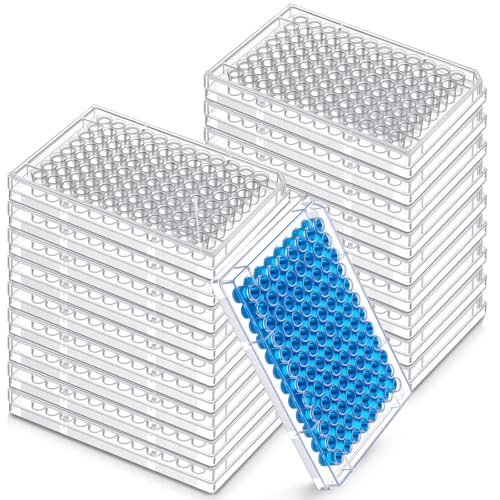
The Weysat 96-well tissue culture plates feature a flat-bottom design to promote even sample distribution and precise optical analysis. Made from optical-grade transparent polystyrene, these plates provide high clarity and smooth surfaces free of burrs, ensuring accurate observation and reliable data gathering. Each plate in the set is compact, lightweight, and designed to meet frequent lab and teaching needs, helping facilities manage consumables efficiently.
Nest Scientific 96-Well Plate, Sterile and Treated

This Nest 96-well plate is tissue culture treated and sterile, made from high-clarity virgin polystyrene. It features vacuum plasma treatment for reliable surface readiness, clear lot number traceability, and peel-to-open packaging for biosafety. The plate is designed for consistent adherence and reproducible results, with easy batch management for larger experiments or teaching labs. Each well is straightforward to identify due to clean labeling and standard well spacing.
Celltreat 229195 96-Well Plate

The Celltreat 229195 plate offers a flat-bottom, clear polystyrene surface with a 0.33 cm2 growth area per well and a lid to reduce evaporation. The wells feature alpha-numeric labeling for quick identification, and the lid mating design includes a raised rim to limit cross-contamination. This setup supports reliable plate handling and stable culture conditions for routine assays and teaching demonstrations.
ADVANGENE U-Bottom 96 Well Plate
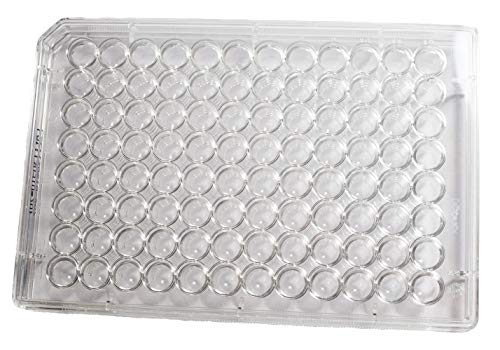
Advangene offers a U-bottom 96-well plate treated for tissue culture, designed to maximize cell adhesion and recovery. The ISO 9001 manufacturing standard supports consistent quality, making this plate suitable for adhesion-dependent cell culture workflows. The U-shaped geometry can improve cell distribution across wells and facilitate uniform imaging and data collection during experiments and high-throughput screening.
SPL 96 Well Plate, Flat Bottom

The SPL Life Sciences 96-well plate features a flat bottom with an effective gas exchange lid inner design and alphanumeric labeling for efficient workflow. This plate is tissue culture treated and sterile, suitable for a broad range of cell culture applications, including adherent cell lines and routine assays. The case of 50 provides a practical balance between inventory management and cost per plate for medium to large labs.
Buying Guide: Key Purchase Considerations
- Bottom geometry: Flat-bottom plates are versatile for most adherent cell cultures and microscopy, while U-bottom plates can improve cell recovery and reduce cross-contamination in some assays. Consider your imaging needs and the cell type when choosing a bottom design.
- Treatment and sterility: Tissue culture-treated surfaces and sterile packaging support reliable cell adhesion and minimize contamination risk. For teaching labs or limited-use experiments, consider cyclic sterilization status and batch traceability.
- Material quality: High-purity polystyrene and optical clarity are important for accurate observations. Burr-free surfaces enhance data integrity during imaging and quantification.
- Lid design and evaporation control: Lids with tight seals and raised rims can reduce evaporation, especially during long incubations or high-throughput assays. Some lids offer better stacking stability for large plate stacks.
- Labeling and traceability: Alpha-numeric markings and lot numbers improve sample tracking, enabling reproducibility and easier documentation in research notes or regulatory compliance.
- Volume and growth area: Check well volume, growth area per well, and gas exchange characteristics to ensure compatibility with your assay volumes, cell density, and incubation conditions.
- Quality certifications: ISO or equivalent manufacturing standards can reflect consistent product quality, an important consideration for institutional purchasing and long-term experiments.
- Packaging and availability: Packs of 50–100 plates balance inventory needs with storage considerations. For teaching labs, larger case quantities can reduce per-plate costs and ensure readiness for class schedules.
When selecting a 96-well plate, align plate features with your experimental workflows, including cell type, assay readouts, imaging requirements, and budget constraints. The products listed offer a mix of flat- and U-bottom designs, sterile packaging, and treated surfaces to support reliable cell culture performance in both research and teaching environments.