When shopping for a 40-plate heat exchanger, you want models that deliver strong heat transfer, high reliability, and straightforward installation. This guide highlights five well-suited options, explains who each is best for, and notes practical considerations. Ideal buyers include residential installers seeking efficient floor heating or water heating, as well as small to midsize commercial operators needing robust, compact units.
Summary table of selected products:
| Product | Brand | BTU Capacity | Plates | ||
|---|---|---|---|---|---|
| ALECOIL 4″x12″-40 Plates | Alecoil | 418,000 BTU/h | 40 | 1″ MPT | View |
| AB Plate Heat Exchanger, 4″x12″ 40 Plates | AB | 350,000 – 380,000 BTU | 40 | 1″ MPT | View |
| AB Plate Heat Exchanger, 5″x12″ 40 Plates | AB | 380,000 – 530,000 BTU | 40 | 1 1/4″ MPT | View |
| 4″x12″ 40 Plates FIQUKI | FIQUKI | Not stated | 40 | 1″ MPT | View |
| ALECOIL 3″x8″-40 Plates | Alecoil | 352,000 BTU/h | 40 | 3/4″ port | View |
ALECOIL 4″x12″-40 Plates Heat Exchanger

Best for high-temperature and high-pressure applications, this Alecoil model uses 316L stainless steel brazed with copper in an oxygen-free furnace. It employs an asymmetric fish bone plate design that creates strong turbulences and moves media in opposite directions for superior heat transfer. The design also reduces secondary-side pressure drop, enabling smaller pumps and lower energy use.
Who it’s best for: installers needing a robust, compact water-to-water exchanger capable of handling demanding heating and industrial refrigerant scenarios. Caution: ensure port fittings match system requirements, as the unit is specified for 1″ MPT connections.
AB Plate Heat Exchanger, 4″x12″ 40 Plates

Best for energy-efficient heating transfers with easy hookup, this AB model uses 316L stainless steel brazed with copper at the edges. It emphasizes a convenient, smooth-thread connection and thin plates for effective heat transfer without excessive energy use.
Who it’s best for: customers prioritizing quick installation and economical operation in floor heating or domestic water heating projects. Limitation: BTU capacity is suitable for medium-load scenarios; verify your load before selecting.
AB Plate Heat Exchanger, 5″x12″ 40 Plates

Best for higher heating loads, this AB unit offers 380,000 to 530,000 BTU per hour with 40 braze plates and a 1 1/4″ MPT interface. The copper edges and stainless steel construction reduce leakage risk while maintaining high pressure tolerance.
Who it’s best for: larger residential or small commercial setups needing significant heating capacity. Caution: larger footprint means it requires more installation space and piping planning.
FIQUKI 4″x12″ 40 Plates Heat Exchanger

Best for versatile industrial and commercial use, this unit emphasizes ultra-high quality materials, copper-stainless steel brazing, and a design that boosts heat transfer efficiency through enhanced turbulence. It notes a claimed 99% improvement in heat transfer over traditional exchangers in its description.
Who it’s best for: operations requiring high thermal performance with robust durability in challenging environments. Limitation: the advanced design assumes proper installation and maintenance; improper setup may negate efficiency gains.
ALECOIL 3″x8″-40 Plates Heat Exchanger
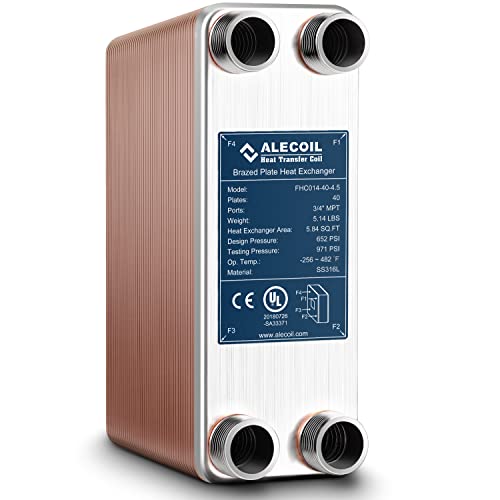
Best for compact, lower-flow applications, this 3″x8″ variant provides 352,000 BTU/h capacity with 40 plates and a 3/4″ port. The asymmetric fish bone design maintains strong heat transfer while minimizing secondary-side pressure drop.
Who it’s best for: smaller setups or retrofit projects where space is limited. Caution: lower port size may require adapters or custom fittings for some systems.
Buying Guide
Key considerations when choosing a 40-plate heat exchanger include capacity, port size, and installation compatibility. Use the following questions to match models to your project.
- What is my heating load and desired BTU/h range? Choose a unit with sufficient capacity to avoid undersizing, which can reduce efficiency.
- What is the required port size and connection type? Ensure the MPT or thread size aligns with existing piping and valves.
- What materials are best for my fluids? Stainless steel 316L with copper brazing provides strong resistance to high temperatures and pressures, with good chemical compatibility.
- Do I need maximum efficiency or a balance of efficiency and cost? Design features like a fish bone plate and high turbulence can improve heat transfer but may affect price and space.
- How easy is installation and maintenance? Look for smooth-thread connections, compact footprints, and clear servicing guidelines.
- What is the expected operating environment? Industrial and commercial uses may demand higher durability and leak resistance than residential setups.
FAQ
- What does “40 plates” imply for performance? It indicates the internal surface area available for transferring heat; more plates generally increase heat transfer capacity, within design limits.
- Are 1″ and 1 1/4″ ports typical for these exchangers? Yes, 1″ and 1 1/4″ MPT ports are common in 40-plate models to accommodate typical heating loop flows.
- Can these exchangers be used for floor heating? Yes, several listed models are designed for water-to-water heat transfer in floor heating systems.
- Do these exchangers require electricity? They primarily transfer heat; some installations use pumps to circulate fluids, which consume electricity.
- Are there installation considerations for high-temperature applications? High temperatures necessitate materials with good thermal endurance and leak resistance; ensure proper sealing and pressure ratings.
- What is the benefit of the fish bone plate design? It creates turbulence to improve heat transfer and can reduce secondary-side pressure drop, potentially lowering pumping energy needs.