If you need a dependable 2 inch discharge sewage pump, you’re looking for devices that can move solids up to 2 inches and handle basement sump or effluent duties. This guide highlights five solid options, explains who each is best for, and shows how to choose the right pump for your setup. The selections prioritize reliability, cast iron construction, and automatic operation to reduce manual effort. Whether you’re dealing with a basement flood, a septic pit, or a sump basin, these pumps are designed to keep water moving and prevent clogs. The table below summarizes the five recommended models.
| Product | Discharge | Best For | Key Benefit |
|---|---|---|---|
| AQUASTRONG 1 HP Sewage Grinder Pump | 2 inch | Basement sump and sewage wells with light to moderate debris | Grinder blades cut through soft debris to reduce clogs |
| LANCHEZ 1HP 6600 GPH | 2 inch | Basements with higher flow needs | High flow; solid handling up to 2 inches |
| VIVOHOME 1 HP Submersible | 2 inch | Residential basements and septic setups | High flow and adjustable auto/manual operation |
| WASSERMANN 3/4 HP | 2 inch | Basement drainage with reliable auto control | Strong 7200 GPH and auto/manual control |
| Acquaer 3/4HP Submersible | 2 inch | Residential sump basins and below-grade installations | Corrosion-resistant cast iron with non-clog impeller |
Aquastrong 1 HP Sewage Grinder Pump
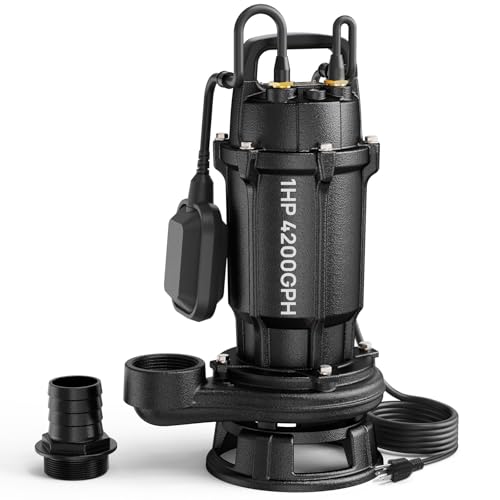
The Aquastrong unit offers a 1 HP grinder pump with a 2 inch discharge and a 4200 GPH flow rate. It uses stainless steel blades to shred soft and semi-rigid debris, helping prevent clogs in sewage systems and basins. Best for basements and ejector pump setups where occasional wipes or lightweight debris are present.
- Best for basements with moderate debris like wipes and twigs
- Up to 40 ft of lift with 115V single-phase power
- 2″ discharge supports solids up to 2″
Limitations: Avoid rubber items or thick towels that may overwhelm the grinder blades. Not intended for gasoline or biogas applications.
LANCHEZ 1HP 6600 GPH Submersible Sewage Pump

The LANCHEZ model features a 1HP PSC motor and can move up to 6,600 GPH with a 2″ discharge. Its cast iron casing adds durability, and an automatic tethered float switch handles on/off control based on water level. Suitable for high-flow basement drainage and sump basins.
- Best for high-flow basement drainage
- Supports up to 2″ solids and 27 ft head
- Automatic float switch with adjustable length
Limitation: The float cable length can be adjusted, but installation height should align with the sump pit to ensure reliable activation.
VIVOHOME 1 HP Submersible Sewage Pump

The VIVOHOME 1 HP unit provides 5220 GPH with a 24 ft head, suitable for residential basements and septic setups. It combines automatic and manual operation with a 14.4 ft power cord and a piggyback plug for easy setup.
- Best for residential basements needing strong flow
- Automatic float switch with manual option
- Auto shutoff on overheating for safety
Limitation: Do not run in water above 104°F (40°C); ensure full submersion when operating.
WASSERMANN 3/4 HP Sewage Pump

This 3/4 HP unit delivers up to 7200 GPH with a 2″ discharge and a 32 ft head. It features automatic and manual operation and a rugged cast iron housing with a non-clogging vortex impeller, ideal for basements and below-grade installations.
- Best for reliable auto operation in basements
- 2″ discharge handles solids up to 2″
- Includes auto/manual control via separate plugs
Limitation: Slightly lower horsepower means it may be less ideal for extremely tall lifts compared to 1 HP models.
Acquaer 3/4HP Submersible Sewage Pump
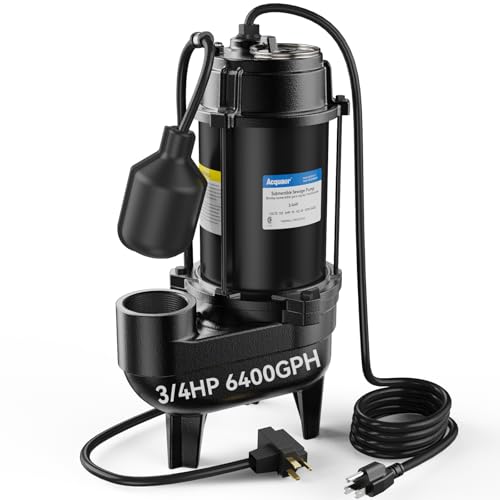
The Acquaer 3/4HP model excels in residential sewage and effluent tasks with a 6400 GPH flow and 29 ft lift. It uses auto/manual operation via a tethered float switch and a 2″ NPT discharge. Construction emphasizes durability and clog resistance.
- Best for residential sump basins and below-grade installs
- 2″ discharge; passes up to 2″ solids
- Auto/manual flexibility with piggy-back plug
Limitation: Not recommended for septic tanks in some regions; verify local code compatibility before installation.
Buying Guide: Key Considerations For 2 Inch Sewage Pumps
- Discharge size and solids capacity: Ensure the pump can handle 2″ solids if your system may encounter larger debris.
- Head height and flow rate: Match the required lift (feet) to your sump height and the need for steady flow (GPH).
- Power Type: Most units run on 115V single-phase; consider models with automatic float switches for hands-off operation.
- Material and durability: Cast iron housings offer durability in basements and harsh environments but weigh more.
- Automatic versus manual: Float switches enable automatic activation; manual control can be useful during testing or maintenance.
- Installation environment: Submersible pumps are suited for basements and sump basins; vent/air flow and water temperature can influence performance.
- Maintenance notes: Look for non-clog impellers and grinder options if debris load is expected to be higher.
Frequently Asked Questions
- What is a 2 inch discharge pump best used for?
Best for basements, sump basins, and effluent systems where solids up to 2″ may be present. - Do these pumps require automatic float switches?
Many models include automatic or tethered switches for hands-off operation, reducing risk of dry running. - Can I mix brands for a sump system?
Yes, but ensure compatible discharge size, power requirements, and electrical codes for your setup. - What maintenance is needed for 2″ pumps?
Regularly check for clogs, inspect the float switch, and ensure the impeller and housing remain free of debris. - Is cast iron better than other materials?
Cast iron offers durability and cooling under heavy use, but may be heavier and more corrosion-resistant environments. - Do these pumps handle cold climates?
Most operate in standard basement temperatures; avoid freezing by proper placement and sealing where applicable.