If you’re shopping for a reliable 110V MIG welder, you’re typically balancing price, versatility and ease of use. These compact, dual-voltage capable machines are designed for beginners and hobbyists who need steady welds on steel, stainless, or aluminum (with the right options). Below are five 110V MIG welders that are well-suited for light fabrication, metal repair, and DIY projects. Each choice highlights who it’s best for, plus practical limitations to consider before buying.
Buying snapshot
| Product | Voltage | Max Amps | Best For |
|---|---|---|---|
| YESWELDER 135A MIG Welder | 110V | 135 A | Beginner to intermediate DIY projects, small steel work |
| ARCCAPTAIN 165A MIG Welder | 110V/220V | 165 A | Versatile home shop work, thicker joints |
| WELDPRO 140A MIG Welder | 110V/220V | 140 A | All-around DIY, occasional aluminum with spool gun |
| Futelo 145A MIG Welder | 110V | 145 A | Compact, portable use for garage and yard tasks |
| ARCCAPTAIN 135A MIG Welder | 110V | 135 A | Budget-friendly starter for basic MIG jobs |
YESWELDER 135A MIG Welder
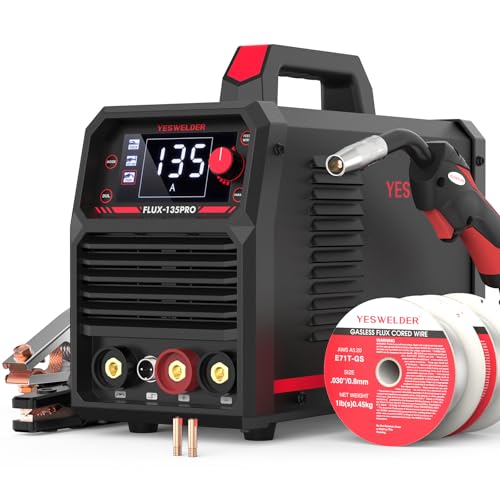
Overview: A compact 3-in-1 machine for Gasless Flux Core MIG, Stick, and Lift TIG (requires additional TIG torch). Best for beginners and hobbyists who want versatility in a budget package. The unit supports mild steel up to about 2.5 mm and works with .030″ to .035″ wires. Synergic wire feed with auto-matched voltage aids first-time welders.
Who it’s best for: Individuals seeking an inexpensive, all-in-one welder for basic metal projects and small repairs. This model is suitable for learners practicing MIG, TIG, and stick with limited thickness capability.
Limitations: Lift TIG requires an extra torch; data suggests limited thickness for ideal TIG performance and the gasless MIG mode favors lighter gauges.
ARCCAPTAIN 165A MIG Welder

Overview: A 4-in-1 machine with 110V/220V dual power, capable of GAS MIG, Flux Core MIG, Lift TIG (torch sold separately), and MMA. Large LED display and an intuitive synergy system help dial in settings for thicker carbon steel and stainless steel. Suitable for DIY, automotive, and fabrication tasks.
Who it’s best for: Welders needing broader capability, plus the option to tackle thicker pieces or alternate welding modes as projects demand. A good pick for a hobbyist expanding beyond basic MIG.
Limitations: TIG readiness depends on purchasing an additional torch; ensure you have space and power support for 220V when needed. 2T/4T modes improve workflow but require familiarization.
WELDPRO 140A MIG Welder
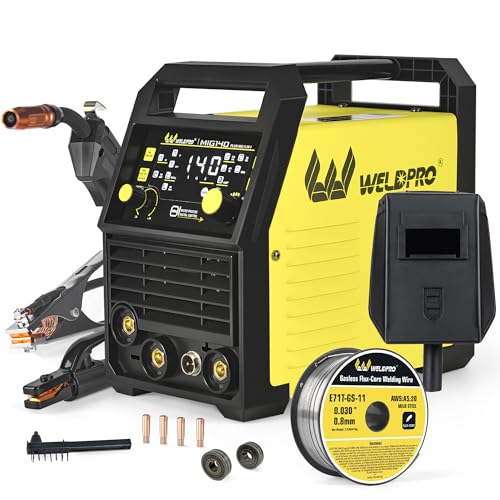
Overview: A 5-in-1 machine featuring SYN MIG, THI MIG, MMA (Stick), Lift TIG, and Spot Welding. Auto-adjusting voltage and wire feed simplify setup for novices, while manual fine-tuning is available for experienced welders. Works with flux core or solid wire and supports spool sizes up to 2 kg/1 kg reels.
Who it’s best for: A versatile option for home workshops that want automated settings with room to customize. Suitable for beginners who intend to grow into more demanding projects.
Limitations: TIG capability requires additional components; thicker metals approach the upper limits of 1-4 mm MIG and 1-6 mm MMA depending on configuration.
Futelo 145A MIG Welder
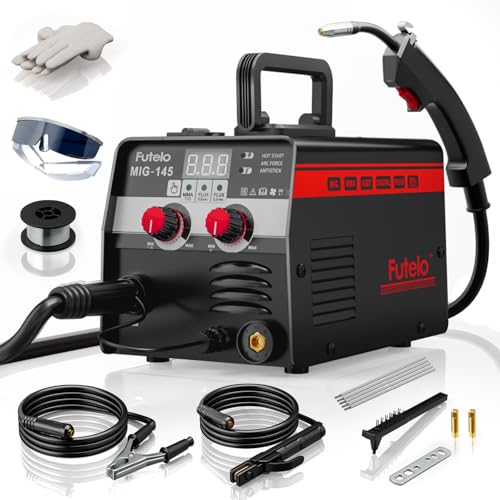
Overview: A compact 3-in-1 welder with Flux Core MIG, Lift TIG, and Stick modes. Offers 30–145A output for 1–5 mm material thickness, and is notably light at around 7.5 pounds for portability. TIG torch is not included and must be purchased separately. Synergy control helps beginners auto-adjust voltage for a smoother start.
Who it’s best for: Ideal for small shops or DIY kits where portability and basic multi-mode welding are priorities. Great for light repairs and hobby projects on metal around the home.
Limitations: TIG torch is not included; lower end of the range is best for thinner metals and lighter tasks.
YESWELDER 165A MIG Welder

Overview: A 4-in-1 unit offering Gas MIG, Flux Core MIG, Spool Gun Aluminum MIG, Lift TIG (additional torch), and Stick. Dual voltage 110V/220V support makes it versatile for various spaces. Synergic MIG simplifies setup for beginners and pros alike, with a broad wire and material compatibility range.
Who it’s best for: Those who want to weld aluminum with a spool gun option and need a flexible, all-around welder for automotive and fabrication tasks. Suitable for users expanding beyond basic steel welding.
Limitations: Additional accessories (lift TIG torch and spool gun) are required for full capability; ensure compatibility with your local power supply and space constraints.
Buying Guide: How to Choose Your 110V MIG Welder
Key questions to guide your choice:
- What thickness will you weld most often? Select a model with a higher amperage if you expect to weld thicker steel beyond 3 mm.
- Do you need dual-voltage (110V/220V)? Dual-voltage units add flexibility for future projects but may cost more and require appropriate outlets.
- Which welding modes are essential? If you only MIG, a simpler 2-in-1 device may suffice; if you foresee TIG or stick welding, consider models that support Lift TIG or MMA.
- Is portability important? Lighter units under 10 lbs are easier to move around a garage or yard, especially for DIY jobs.
- What accessories come with the unit? TIG torches, spool guns, and extra consumables add to capability but also cost.
- What wire size and spool options does it support? Check compatibility with your preferred flux core or solid wires and spool weights.
Practical tips for buyers
- For beginners, choose a welder with synergic control and clear LED displays to simplify setup.
- If you plan outdoor or wind-exposed work, flux core (gasless) welding is typically more forgiving than gas-shielded MIG.
- Consider how easy it is to change wire spools, drive rolls, and torch configurations as your projects scale.
FAQ
- What does 110V mean for a welder’s performance? It indicates compatibility with standard household outlets; amperage and duty cycle determine how thick and long you can weld.
- Do these welders require shielding gas? Many 110V MIG welders support flux-core wire (gasless) for outdoor use, but some models also support gas shielded MIG with options.
- Can you weld aluminum with these machines? Some models support aluminum via a spool gun; check the product’s listed capabilities and required accessories.
- Is a dual-voltage unit always better? Dual-voltage offers more flexibility for future projects, but it may be heavier and costlier than single-voltage models.
- What safety features should I expect? Look for thermal protection, overload protection, and clear parameter displays to reduce misconfigurations.
- What gauge materials are typical for 110V MIG welders? Most handle light to medium thicknesses around 1–4 mm, with some models supporting up to about 5 mm under ideal conditions.