If you’re shopping for a plate heat exchanger, you want a model that delivers reliable heat transfer, durable materials, and clear installation options. This guide targets buyers seeking water-to-water and air-to-water heating or cooling solutions for radiant floors, snow melting, beer cooling, or industrial use. The top picks below are chosen for strong build quality, high heat transfer efficiency, and practical port configurations. A quick snapshot table follows to compare core specs at a glance.
Product Summary
| Product | Brand | Heat Capacity (BTU/h) | Plates | Port Size | Best For |
|---|---|---|---|---|---|
| VEVOR Brazed Plate Heat Exchanger, EATB28-50 | VEVOR | 500,000–660,000 | 50 | 1 1/4″ MPT | Floor heating and water heating |
| AB Plate Heat Exchanger, 5″x12″ 50 Plates | AB | 500,000–680,000 | 50 | 1 1/4″ MPT | Floor heating and water heating |
| AB Plate Heat Exchanger, 3″x 8″ 50 Plates | AB | 160,000–380,000 | 50 | 3/4″ NPT | General water heating and cooling needs |
| AB Plate Heat Exchanger, 4″x 12″ 50 Plates | AB | 400,000–450,000 | 50 | 1″ MPT | Floor heating and snow melting |
| ALECOIL 5″x12″ 50 Plates | Alecoil | 748,000 | 50 | 1 1/4″ port | High-temperature/pressure applications |
VEVOR Brazed Plate Heat Exchanger, EATB28-50 (50 Plates)

Best for: Home installations requiring a robust, high-capacity heat exchanger for floor heating, water heating, or beer cooling. This unit uses 316L stainless steel with copper brazing at critical joints for leak resistance and durability. It supports high pressure and temperatures, making it suitable for demanding residential or light commercial use. The asymmetrical herringbone plate pattern enhances turbulence to improve heat transfer efficiency, aiming for up to 99% heat transfer efficiency and potential energy savings. The 5″x12″ plate size and 50 plates yield a large exchange area for strong performance.
Why chosen: It combines premium materials, strong heat transfer design, and a high plate count to maximize heat exchange in larger residential systems. The combination of 316L stainless steel and copper brazing helps resist corrosion and leaks under varied operating conditions.
Limitation: Data notes a broad operating range (-292℉ to 392℉) but does not specify installation constraints for specific hydronic systems. Ensure compatible piping and pump capacity for best results.
AB Plate Heat Exchanger, 5″x12″ 50 Plates
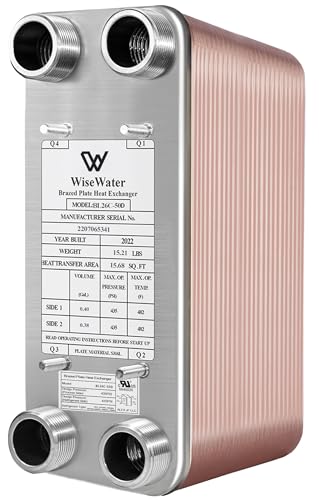
Best for: Home or light commercial setups needing a compact yet high-capacity water-to-water exchanger for radiant floors or snow-melt projects. The unit uses 316L stainless steel with copper brazing at the edges for a robust construction that resists leaks under pressure. It supports 500,000–680,000 BTU per hour and offers straightforward 1 1/4″ MPT connections.
Why chosen: The premium copper-brazed joint design and large plate count deliver strong heat transfer while maintaining a compact footprint. The smooth-thread connections simplify installation and reduce leak risk.
Limitation: The product relies on relatively high flow to achieve its rated BTU range; ensure your system can provide adequate flow without excessive pressure drop.
AB Plate Heat Exchanger, 3″x 8″ 50 Plates

Best for: Compact heating or cooling tasks in smaller residential systems where space is limited but capacity is moderate. The 3″x8″ plate arrangement with 50 plates provides a balance of heat transfer area and installation footprint. It uses 316L stainless steel with copper brazing for durability and leak resistance. It is suitable for water-to-water transfers in floors, space heating, or small snow-melt setups.
Why chosen: The smaller footprint is advantageous when retrofit installations are constrained. The 1/4 inch NPT connections allow compatible adapters and flexible installation options.
Limitation: Lower BTU capacity relative to larger plate models means this unit may not meet very high heating loads without parallel units or staged operation.
AB Plate Heat Exchanger, 4″x 12″ 50 Plates

Best for: Medium-to-large heating or cooling tasks in radiant floor systems or snow-melt projects where space permits a larger plate area. The 4″x12″ plate layout yields substantial heat transfer with a 1″ MPT port, making this model a solid option for diverse hydronic applications. Constructed from 316L stainless steel and copper-brazed edges for reliability.
Why chosen: The higher heat transfer area supports more demanding loads while maintaining a compact overall size. The 50-plate configuration provides strong performance without excessive equipment footprint.
Limitation: Installation may require more precise flow and pressure considerations; ensure the system pump and piping are sized to avoid excessive pressure drop.
ALECOIL 5″x12″ Plate Exchanger, 1-1/4″ MPT

Best for: Heavy-duty water-to-water configurations demanding high-temperature and high-pressure performance, such as commercial or industrial heating and cooling, or high-demand radiant systems. The ALECOIL design uses 316L stainless steel with copper brazing in an oxygen-free furnace to maximize strength and corrosion resistance. It provides up to 748,000 BTU/h capacity with a 5″x12″ plate array.
Why chosen: The asymmetric plate design and large heat transfer area support efficient heat exchange for demanding installations. It also benefits from a robust port configuration and proven material quality.
Limitation: Higher capacity units may require more powerful pumps and careful system balancing to maintain efficiency and avoid over-sizing.
Buying Guide
What should I consider when choosing a plate heat exchanger?
- Heat transfer capacity: Match BTU/h needs to your climate, space heating, or cooling load. Larger plate counts generally support higher capacities.
- Plate size and count: Larger plates increase surface area; ensure your installation space can accommodate the unit.
- Materials and brazing: 316L stainless steel with copper brazing offers corrosion resistance and leak protection; verify material quality for your application.
- Port sizing and connections: Common options include 1/4″, 3/4″, and 1″ MPT; ensure compatibility with your piping and pumps.
- Operating temperature and pressure: Check the unit’s rated range and ensure your system operates within it.
- Maintenance and leaks: Brazed plate exchangers are compact and leak-resistant, but consider ease of refilling and cleaning in your system design.
Best practices for installation and use
- Plan for optimal flow: Avoid excessive pressure drops by matching pump sizing to the exchanger’s requirements.
- Use correct gaskets and seals if applicable: While many brazed units are leak-proof, correct piping and fittings reduce risk during installation.
- Monitor system temperatures: Ensure inlet and outlet temperatures remain within recommended ranges to maximize efficiency.
- Consider future expansion: If you anticipate higher loads, select a unit with a higher BTU/h rating or add a second exchanger in parallel.
Comparison at a glance
- Best for high-demand radiant heating: VEVOR EATB28-50 and AB 5″x12″ 50 Plates models.
- Best for compact spaces: AB 3″x8″ 50 Plates and AB 4″x12″ 50 Plates offer smaller footprints with solid capacities.
- Best for heavy-duty industrial needs: ALECOIL 5″x12″ 50 Plates with high BTU/h capacity.
Frequently Asked Questions
- What is a plate heat exchanger used for? It transfers heat between two liquids, often used in radiant floor heating, water heating, snow melting, or beer cooling systems.
- Why choose brazed plate exchangers? They are compact, durable, and resistant to leaks, with good heat transfer due to plate design and copper brazing.
- What does 50 plates mean? It refers to the number of plates inside the unit, which directly influences heat transfer area and capacity.
- What port size should I select? Choose based on your piping (1/4″, 3/4″, 1″ MPT are common) and ensure compatibility with your pump and fittings.
- Are these exchangers suitable for high-temperature applications? Yes, many models are designed for wide temperature ranges; verify the exact range for your chosen unit.
- Do these exchangers require electricity? They transfer heat without active energy use, though pumps and circulating equipment will manage the flow.