Answering the need for reliable, efficient feed production, this guide highlights five livestock feed mill machines suited for poultry, swine, and ruminants. Each pick balances output, versatility, and practicality for farm workrooms, barns, and homesteads. The top choices span compact grinders to multi-disc pellet mills, with notes on ideal users and potential limits. Use the quick buying table below to compare at a glance.
| Product | Best For |
|---|---|
| Hatching Time Farm Mill Compact Feed Grinder | Small-batch mixing, chicks to small ruminants |
| ProXlex 220V Pellet Feed Machine | Medium-scale pelletizing, mixed livestock feed |
| ProXlex Upgraded 110V Pellet Mill | Compact spaces, higher output per hour |
| YADSWB Commercial Poultry Feed Grinder | Heavy-duty, continuous operation |
| ProXlex 220V 4-Head Pellet Mill & 5.5KW | Frequent pelletizing, versatile discs |
Hatching Time Farm Mill Compact Feed Grinder 110V

Best for small-batch poultry and livestock feed preparation, this compact grinder runs at high speed to process dry grains efficiently. It supports a consistent particle size with interchangeable 2–5 mm screens, making it suitable for chicks, growers, layers, ducks, and small ruminants. Its compact footprint suits workshops, barns, and homestead feed rooms. It discharges directly into a container for flexible batching.
Key features include a 19,000 RPM motor for quick processing and 1.0 kW of power, which helps keep energy use reasonable on small operations. The ability to switch screen sizes lets a user tailor texture for different animals without buying multiple machines. A cautious note: small-scale capacity means longer sessions for larger groups, and screen wear can affect output consistency over time.
ProXlex 220V Pellet Feed Machine

Best for farms needing a robust multi-disc pellet mill with multiple die options, including 2.5, 3, 4, 5, 6, and 8 mm. This 4-head roller design helps deliver stable output and reduces clogging, supporting poultry and livestock feeds across growth stages. The 5.5 kW motor delivers high efficiency and a maximum output around 507 lb/h, with an enlarged feed port improving feeding ease.
Who this is for: mid-sized operations seeking steady pellet production and flexible feed textures. Better for farms with varying livestock diets. Caution: higher power draw requires a suitable electrical setup; ensure proper ventilation and safety clearances around the motor and rollers.
ProXlex Upgraded 110V Feed Pellet Mill Machine

Best for compact spaces that still demand solid pellet output, this 110V mill uses 4 head rollers and six die discs (2.5/3/4/5/6/8 mm) to accommodate varied livestock diets. It’s designed for continuous operation with a copper motor, reducing heat buildup and enhancing reliability. Maximum output is about 440 lb/h, and a separate control box simplifies operation and maintenance.
Choose this if you need a compact machine with reliable 110V operation and multiple die sizes. A limitation to watch: the 440 lb/h ceiling may require staged production for larger herds or frequent bulk needs.
YADSWB Commercial Poultry Feed Processing Chopper
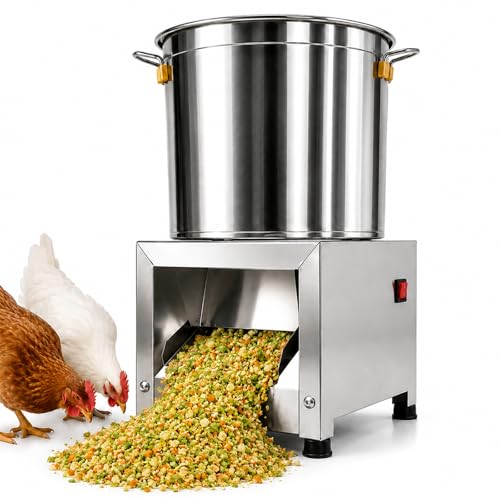
Best for high-capacity, industrial-style chopping and grinding, this 1800W chopper operates at up to 3500 RPM and processes up to 200 kg/h. Constructed from heavy-duty 304 stainless steel, it resists rust and is suited for continuous heavy use in farms, coops, or small processing facilities. Its titanium-alloy blades stay sharp and help reduce jams with an anti-clog design.
Use this when you need fast, large-volume grinding. Limitation: designed more for chopping than precise pelletizing; consider pairing with a pellet mill if pellets are the goal.
VEVOR Livestock Hay Feeder and Grain Holder

Best for minimalist feeding setups, this 2-in-1 hay rack and grain tray feeder holds 56 gallons of hay and 24 gallons of grain in a single unit. Built with heavy-duty steel, it withstands outdoor use and flock activity. A bottom tray collects loose hay to help keep feeding areas cleaner. The safety-focused design features rounded edges and smooth corners to reduce injuries during feeding.
Choose this if you want combined hay and grain access in one unit with easier cleaning. Limitation: not a dedicated pellet-milling device; for pellet production, pair with a separate mill as needed.
ProXlex 220V 4-Head Pellet Mill with 6 Discs
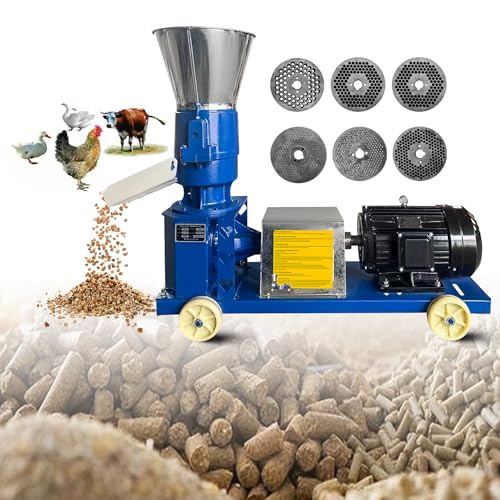
Best for farms needing versatile pellet textures, this 220V machine includes 6 grinding discs (2.5/3/4/5/6/8 mm) and 4 steel rollers. The copper motor and anti-clog design support stable output and longer service life. It’s suitable for creating poultry feed across growth stages with a reliable discharge rate around 507 lb/h.
Good for: farms that require frequent pellet changes and larger throughput. Caution: ensure electrical capacity supports 220V operation and appropriate room for the mill footprint.
Buying Guide: Key Considerations for Livestock Feed Mill Equipment
- Scale and throughput: Match the machine’s hourly output to your herd size and feeding schedule. For smaller flocks, compact grinders may suffice; larger operations may need higher-capacity pellet mills.
- Feed texture and versatility: If you need different textures, look for multiple die sizes or interchangeable screens. This helps tailor texture for chicks, growers, layers, or ruminants.
- Electrical requirements: Check voltage and phase (110V vs 220V) and ensure your workshop has appropriate electrical infrastructure and safety clearances.
- Construction and durability: Stainless steel or heavy-duty steel frames improve longevity in farm environments. Consider anti-jam designs for continuous feeding.
- Maintenance and safety: Look for accessible parts, simple cleaning procedures, and built-in safety features to protect operators during loading and operation.
- Footprint and placement: Compact units suit homestead or small barns, while larger mills require more floor space and stable mounting to reduce vibration.
- Cost of operation: Consider energy use, blade and die wear, and potential downtime when evaluating total cost of ownership.
Frequently Asked Questions
- What size pellet mill do I need for a small farm? – For small farms, a compact 110V or 220V machine with 2.5–5 mm discs often provides enough throughput and flexibility for poultry and small livestock.
- Can these machines handle different feed textures? – Yes, many models offer multiple discs or screens to adjust texture for various growth stages and animal types.
- Is 220V power essential? – It depends on the model and desired throughput. 220V systems generally support higher output, but 110V models can work for smaller operations.
- Are stainless steel parts important? – They improve durability and hygiene in farm settings, especially for wet or humid conditions.
- Do these machines require special maintenance? – Regularly inspect blades, rollers, and screens; keep the feed ports clean; and follow the manufacturer’s maintenance guide for optimal performance.
- Can I use these tools to process hay or grains for goats? – Yes, many units support grains for poultry and small ruminants, but verify the recommended feed types for each model before use.