Whether you’re running pneumatic tools in a busy workshop or stocking a maintenance bay, an 80-gallon horizontal air compressor tank can deliver sustained air flow with less downtime. This guide highlights five top picks that balance capacity, reliability, and performance. Each option is suited for professional shops, manufacturing setups, or serious DIYers who need steady air supply and easy integration into existing systems.
Product Comparison Snapshot
| Product | Type / Tank | Key Benefit | Best For |
|---|---|---|---|
| Campbell Hausfeld 80 Gallon Horizontal Two‑Stage | Horizontal tank, 5 HP, 230V | High CFM at 90 PSI; durable two‑stage pump | Professional shops needing sustained air for multiple tools |
| VEVOR 80 Gallon Air Compressor, Oil Free | 80-gallon, oil-free, 6.5 HP | Fast inflation, low maintenance oil-free design | Industrial workflows with quick air bursts and quieter operation |
| VEVOR 80 Gallons Heavy‑Duty, 10 HP | 80-gallon, belt-driven, 3‑phase ready | Very high airflow and fast pressurization | Large workshops needing robust, continuous air supply |
| HPDAVV Rotary Screw 80-Gallon with ASME Tank | 80-gallon, rotary screw, ASME tank | Continuous duty, stable pressure with low noise | Auto shops and industrial environments demanding quiet operation |
| Eastwood Elite 80 Gallon Auxiliary Tank | Auxiliary 80-gallon tank | Adds reserve air capacity to existing systems | Extending air reserves in larger setups |
VEVOR 80 Gallon Air Compressor, Oil Free

The VEVOR 80‑gallon oil‑free unit features a 6.5 HP motor and can deliver up to 15.5 SCFM at 90 PSI. Its oil-free design reduces maintenance and minimizes the risk of oil contamination in your air line. With a large 80‑gallon tank, this model supports longer tool cycles between fills and helps maintain steady pressure during manufacturing tasks. Best for shops that need quick inflation and lower ongoing maintenance, especially where oil management is a concern.
- Best for: Medium to large workshops needing fast air delivery and low maintenance.
- Why selected: Combines a sizeable tank with efficient, oil-free operation for cleaner air and reduced downtime.
Caution: Oil-free pumps can run “hotter” under heavy continuous load; ensure adequate ventilation and follow manufacturer heat management guidance.
VEVOR 80 Gallons Heavy-Duty Air Compressor
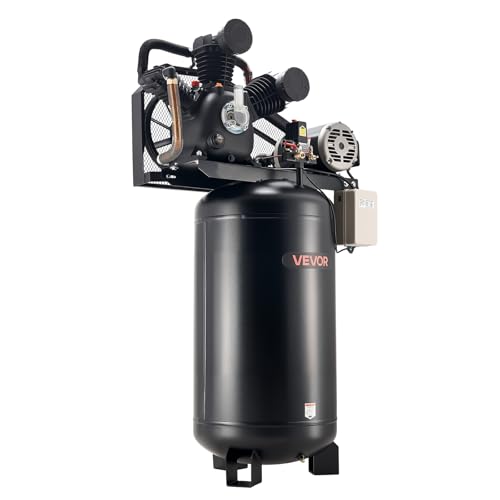
This 80‑gal heavy‑duty model uses a 10 HP motor to deliver 17 SCFM at 90 PSI and reaches up to 175 PSI. The belt‑driven pump enhances efficiency and stability, and an oil observation mirror lets users check oil levels at a glance. Two air outlets enable simultaneous operation of two tools, boosting productivity in manufacturing environments. Note that installation requires a suitable 3‑phase power supply for operation.
- Best for: Facilities needing high airflow and dual‑tool capability.
- Why selected: Powerful performance with straightforward monitoring and dual outlet flexibility.
Caution: Requires 3‑phase power; verify electrical capacity and wiring before purchase.
Campbell Hausfeld 80 Gallon Horizontal Two‑Stage Air Compressor

Campbell Hausfeld’s 80‑gallon horizontal two‑stage compressor combines high capacity with a 5 HP, 230V motor. It delivers up to 17.2 CFM at 90 PSI and a maximum of 175 PSI, supporting demanding shop air tools and continuous operation. The two‑stage pump is designed for long service life in professional environments, making it a dependable backbone for serious pneumatic work.
- Best for: Professional shops requiring consistent air flow for multiple heavy tools.
- Why selected: Reliable two‑stage pumping with generous tank capacity supports extended use without frequent recharges.
Caution: Larger installations may require dedicated electrical and floor space planning for the horizontal tank layout.
HPDAVV Rotary Screw 80‑Gallon With ASME Tank

HPDAVV pairs a rotary screw system with an 80‑gallon ASME tank for continuous duty and reduced noise. At 150 PSI and about 15 CFM, this unit supports long‑run tool operations with stable pressure. It operates on standard 230V/60Hz single‑phase power, which helps simplify wiring in smaller commercial spaces or mobile service setups.
- Best for: Noise‑sensitive environments that still require continuous air supply.
- Why selected: Rotary screw design minimizes pulsation and provides steady performance over long cycles.
Caution: Rotary screw systems can be more complex to install and service than piston‑driven units; ensure proper maintenance access.
Eastwood Elite 80 Gallon Auxiliary Air Compressor Tank

The Eastwood Elite 80 Gallon Auxiliary Tank is designed to augment an existing compressed air system. It provides additional reserve air capacity, which helps manage peak tool demands and reduces compressor cycling. This accessory is best paired with compatible Eastwood equipment or other 80‑gallon systems to expand overall air storage without a full replacement.
- Best for: Expanding air reserves in established shops or retrofit projects.
- Why selected: Simple way to boost capacity without altering core equipment.
Caution: Does not replace a primary air supply; ensure compatibility with your current compressor setup.
Buying Guide: Key Considerations for 80 Gallon Horizontal Tanks
How much air do you need?
Assess your tools’ airflow requirements in CFM at your typical operating PSI. Higher CFM at your target PSI means faster tool operation and less downtime waiting for pressure to recover. If you run many tools or continuous cycles, look for models with 15–20+ CFM at 90 PSI or equivalent performance.
Power supply and electrical needs
Horizontal tanks often require 230V single-phase or three‑phase power. Confirm that your shop wiring can handle the load and that the motor horsepower aligns with your electrical capacity. Three‑phase units may deliver higher performance but require professional wiring.
Maintenance and longevity
Oil‑free designs reduce maintenance but can run hotter under heavy use. Oil‑lubed, two‑stage pumps can offer long life in high‑duty environments. Regular checks of oil (for oil‑lubed models), belt tension (for belt‑driven units), and tank integrity are essential for reliability over years of use.
Noise and indoor use
Noise levels matter in enclosed workshops. Oil‑free and rotary screw configurations generally run quieter than traditional piston compressors. Consider dedicated ventilation or sound-dampening approaches if noise is a concern.
Tank orientation and space
Horizontal tanks save floor space and allow easier placement beside benches or walls. Measure your workspace to ensure the chosen unit fits and that service access and maintenance clearances are preserved.
Outlets and tool compatibility
Two outlets or more offer flexibility for simultaneous tools. If you run multiple tools at once, verify the outlets and pressure stability across the operating range.
Frequently Asked Questions
-
What is the advantage of an 80‑gallon tank?
It provides extended run times between fills and a steadier pressure, which reduces tool cycling and improves productivity in busy shops.
-
Is oil-free better than oil-lubricated for air compressors?
Oil-free designs require less maintenance and produce cleaner air, but oil-lubed units can handle heavy use with long service life when properly maintained.
-
Do I need specialized electrical wiring for a large 80‑gallon compressor?
Yes. Some models require 3‑phase power or dedicated circuits. Check your building’s electrical capacity and consult a licensed electrician if needed.
-
Can I use an 80‑gallon tank in a home garage?
It depends on space, ventilation, and noise considerations. Choose a model with lower noise and ensure proper clearance and ventilation for safe operation.
Buying an 80‑gallon horizontal air compressor tank involves balancing capacity, power needs, and maintenance. The options above cover a range of configurations—from oil-free and belt-driven to rotary screw designs—so you can select the best fit for your shop layout and production demands.